The Value Creation Intelligence System
A Value Creation Architecture Above and Beyond AI, ERP Systems, and Spreadsheets.
It is not a failure of leadership that most companies do not systematically overperform, because they were never designed to do so. At the same time, the expectation remains unchanged. Companies are expected to strive for excellence, deliver sustained performance, and continuously increase enterprise value. The constraint is therefore not ambition or capability, but the absence of a value creation architecture that translates these ambitions into a structured and repeatable system of delivering outcomes.
This is directly relevant for the CEO, CFO, and COO office, as well as Strategy leaders, Value Management Offices (VMOs), and PMOs. It defines the next generation of management, one that has been long overlooked, not because of lack of awareness, but because the architecture to support it did not exist. With that architecture in place, value creation becomes structured, governed, and continuously improved across the enterprise.
Most organizations today are well instrumented. ERP systems structure transactions, business intelligence systems provide visibility into performance, and execution tools coordinate activity across teams. Spreadsheets continue to fill the gaps between these systems. What remains largely unstructured is value creation itself. Strategy is defined, but not consistently anchored in the underlying drivers of value. Execution is active, but not always aligned with what matters most. Measurement exists, but rarely links actions to enterprise value outcomes in a continuous way.
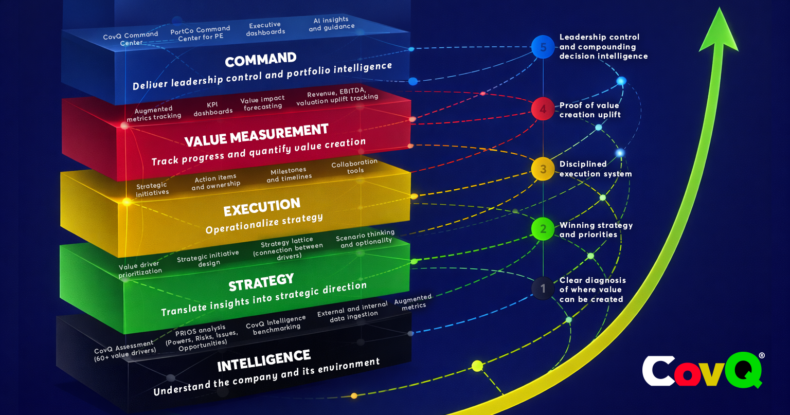
The Value Creation Intelligence System addresses this gap by introducing a multi-layered architecture that operates above and beyond existing enterprise systems and defines how they are used in the context of value creation. It forms the core system architecture of the CovQ Value Creation Management Platform. Rather than replacing ERP, BI, or workflow tools, it provides a unifying logic that connects insight, strategy, execution, and outcomes into a single operating model. This architecture is reflected in the layer graph and is powered by a value-driver-based neural network that continuously connects and recalibrates how value is understood, prioritized, and executed across the organization.
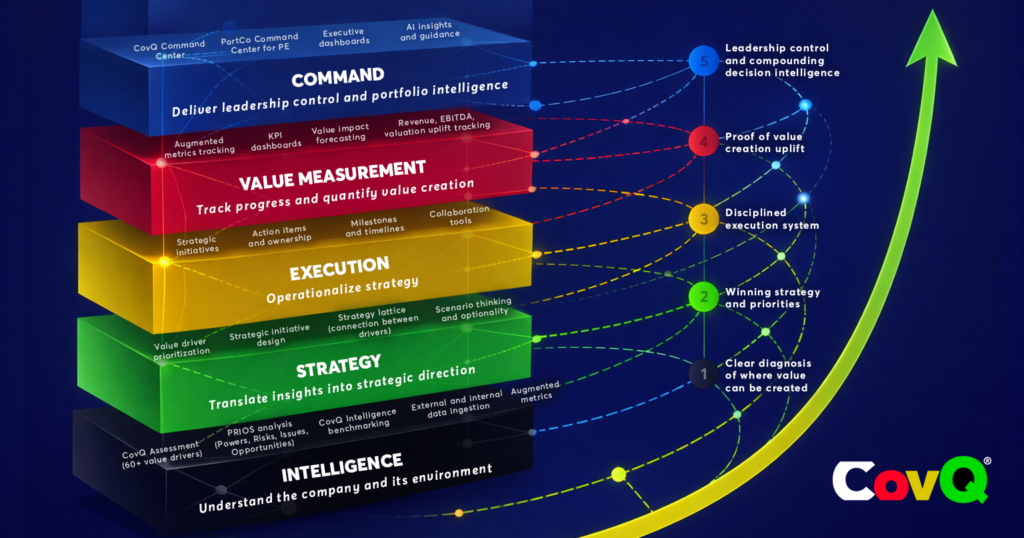
At its foundation, the Intelligence layer establishes a structured understanding of the business through value drivers, assessments, and benchmarking. The Strategy layer translates this understanding into direction, anchoring priorities and initiatives in those drivers. The Execution layer ensures disciplined delivery by linking ownership, actions, and progress directly to strategic intent. The Value Measurement layer connects execution to outcomes, quantifying impact in terms of ROI and enterprise value uplift. The Command layer provides leadership with continuous visibility and control across the system.
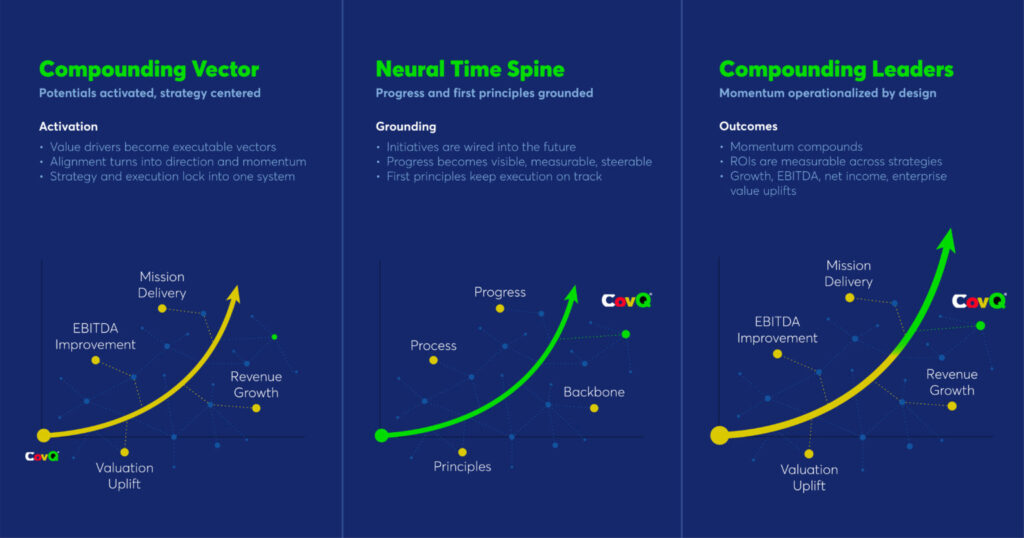
The impact of this architecture lies in its coherence. When these components operate in isolation, organizations experience the familiar disconnect between strategy, execution, and results. When integrated through a unified system and reinforced by the underlying neural network, the organization functions as a continuous value creation system in which each cycle informs and improves the next.
In practice, this does not require replacing existing strategies. They can be integrated from the outset and strengthened within a consistent value creation logic. Execution becomes more focused, alignment improves, and measurement becomes meaningful because it reflects actual impact. Over time, a structured operating cadence emerges, creating consistency across the organization.
Artificial intelligence plays an important but clearly defined role. It enhances analysis, supports decision-making, and improves execution, but it does not define the structure within which value is created. The Value Creation Intelligence System, as part of the CovQ Value Creation Management Platform, provides that structure by connecting insight, strategy, execution, and outcomes into a coherent whole, with the neural network ensuring that relationships between value drivers, actions, and outcomes are continuously refined. Within this framework, AI strengthens each layer, while without it, AI remains fragmented across tools and use cases. The system is designed to integrate AI where it adds value and to operate with standalone AI capabilities where required, without breaking the integrity of the overall architecture. Efficiency gains alone, however, have natural limits, as there is only so much cost that can be reduced before it constrains the business itself. When AI is applied within a value creation system, the focus shifts from efficiency to growth, where the potential is not bounded in the same way and can expand continuously when activated.
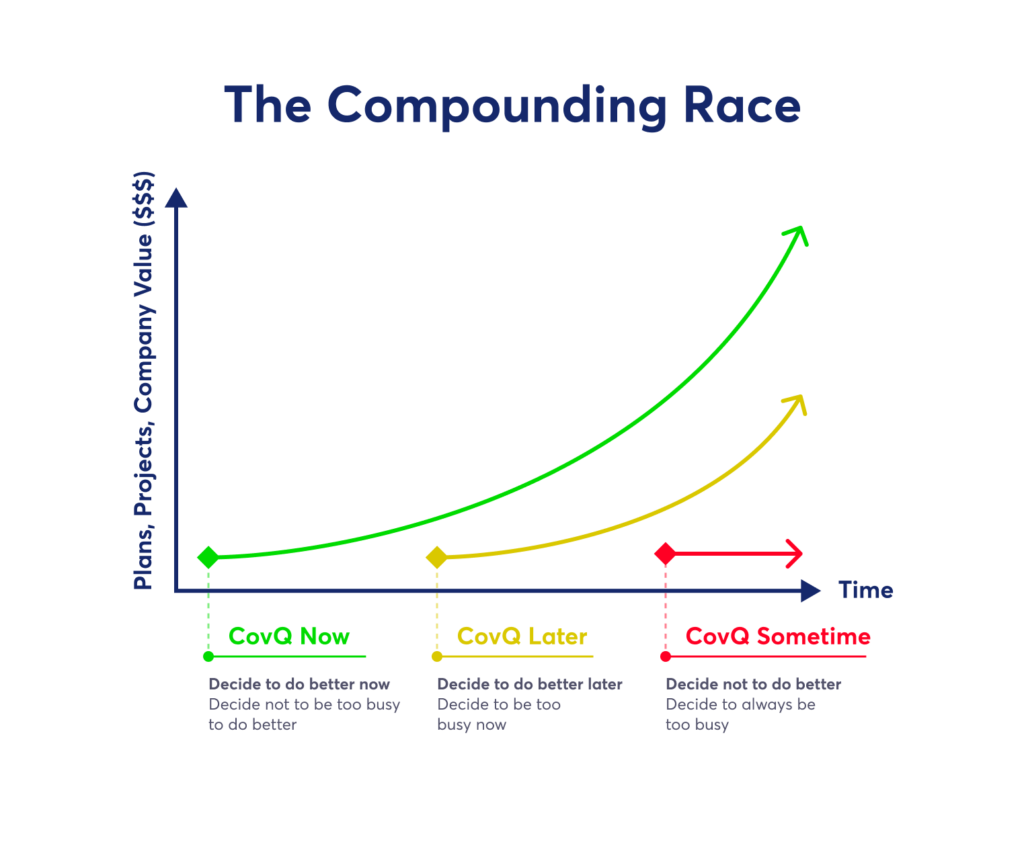
The defining characteristic of the system is its ability to compound. Each cycle of understanding, prioritizing, executing, and measuring improves the next, leading to sharper decisions, more disciplined execution, and increasingly predictable outcomes. Over time, excellence becomes embedded in the system itself, with overperformance emerging as a natural consequence.
This shift from fragmented activity to integrated value creation is best understood through its effects in practice.