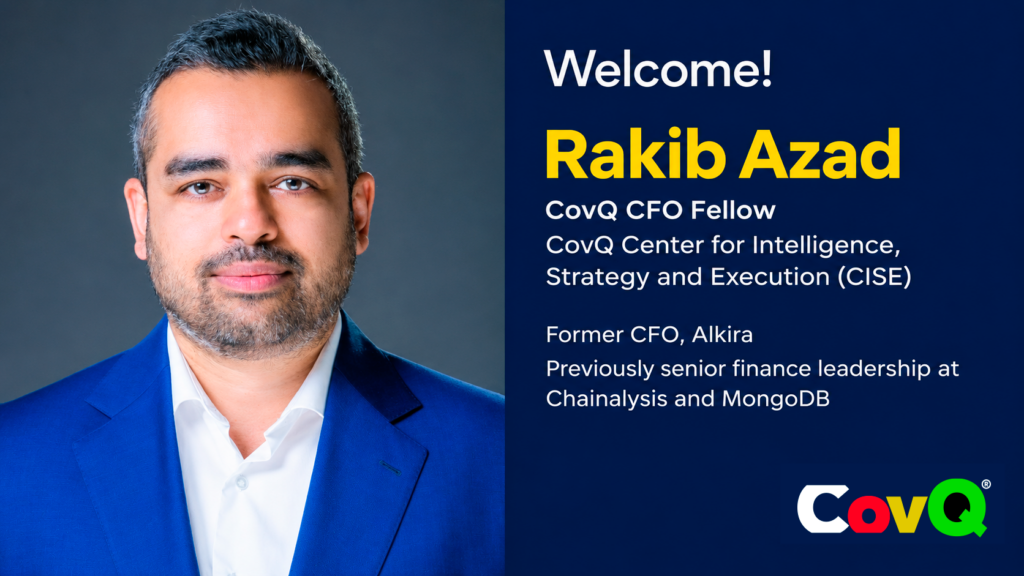


By Alex Clemente
Director, CovQ Center for Intelligence, Strategy, and Execution (CISE)
Former Founding Managing Director, Harvard Business Review Analytic Services
Every executive team aspires to set inspiring, forward-thinking corporate goals. Whether it is expanding a global footprint, accelerating digital transformation, or dominating a new market segment, broad strategic objectives provide an organization with its sense of direction and ambition. However, a critical failure can occur when these macro goals are treated purely as qualitative ideals. When enterprise priorities are not anchored to concrete financial performance metrics, an organization may suffer from strategic drift, capital inefficiency, and a breakdown in operational reality.
The Nearsightedness of Growth at All Costs
The most glaring consequence of divorcing organizational goals from financial realities is the pursuit of unprofitable growth. Organizations such as Webvan, Theranos, and WeWork provide a cautionary tale. If a company’s primary business ambition is “growth at all costs,” and not tied to strict margin, return on capital, or profitability thresholds, teams will likely adjust their behavior to hit the volume target by any means necessary.
In my professional experience, companies rarely fail because they lack goals. They fail because different functions quietly target different goals. Marketing pursues awareness, sales pursues bookings, operations pursues efficiency, and finance pursues margin. Unless leadership establishes a common value-creation metric, these objectives eventually can begin to compete with one another.
Salesforces can slash prices, marketing budgets can be ratcheted up, and operations can expand inefficiently. While the high-level goal of expansion might be technically achieved, the underlying business destroys its cash reserves and erodes its long-term financial health. Or as Allan Gilmour, former CFO of Ford Motor Company, once said, “Growth is dandy, but sustainable growth is better. And sustainable growth requires a profit.”
When Capital and People Lose Sight of Alignment
Corporate goals are meant to guide how a company allocates its two most valuable resources: capital and human talent. When these goals lack an explicit link to financial performance metrics—such as Return on Invested Capital (ROIC), cash flow generation, or EBITDA expansion—capital allocation can become highly subjective.
Some projects get funded based on CEO hubris, political influence, or internal hype rather than economic viability. An organization might invest heavily in a high-profile corporate initiative simply because it sounds strategic, while starving core, highly profitable business lines of the capital they need to sustain themselves.
When growth mandates exist independently of financial metrics, it creates alignment issues for the workforce. Mid-level managers and individual contributors are usually managed by the reality of budgets, departmental costs, and strict financial constraints. If executive leadership continually champions growth that has no visible connection to the financial realities of running the business, employees become cynical. They perceive strategy as a separate, executive-level narrative that has no bearing on actual operational health or day-to-day business survival.
While a compelling strategic vision can initially excite investors and the board, sustained long-term valuation is always rooted in economic performance. Leadership cannot indefinitely defend a goal of “technological leadership” or “brand dominance” if the financial metrics show declining margins, rising debt, or stagnant revenue. When qualitative milestones are met but financial statements fail to keep pace or deteriorate, stakeholders quickly lose confidence in management’s ability to steer the company. The premium on the company’s valuation compresses, and access to capital dries up.
Connecting Vision to Economic Value
To build a resilient and sustainable enterprise, organizational goals and financial execution must be treated as two sides of the same coin. Every high-level objective must be explicitly mapped to a financial outcome. If the goal is innovation, it must be measured by the revenue generated from new products within a specific timeframe. If the goal is operational excellence, it must be explicitly tied to cost reduction, reduced inputs or other cost efficiencies. By ensuring that every strategic objective is directly accountable to the financial engine of the business, companies ensure their vision drives sustainable, long-term economic value.
Ensuring corporate goals deliver economic value is critical and using the integrated approach of an end-to-end value creation management platform like CovQ is key. Where intelligence, strategy, execution, and financial performance come together in one central system. We can help you accomplish that.